How to Avoid Crypto Liquidation: 5 Rules That Actually Work
Stop getting wicked out of leveraged crypto positions. Five concrete rules — with example numbers — that have kept disciplined traders unliquidated for years.
 By Archit Mittal
If you've been liquidated more than twice this year, the problem isn't your luck. It's that one or more of these five rules is missing from your trading routine.
These aren't theory. They're the rules used by professional crypto traders who haven't been liquidated in years.
Rule 1: Calculate leverage from your stop, not the other way around
Wrong: "I'll use 25× because the move feels easy."
Right:
- Where will I exit if wrong? (e.g., -3% from entry)
- How much can I lose? (e.g., 2% of account)
- Leverage = max-risk ÷ stop-distance = 2 ÷ 3 = 0.67×
That's right — sometimes the math says use less than 1x (i.e., don't use any leverage at all). Most traders refuse this answer and over-leverage.
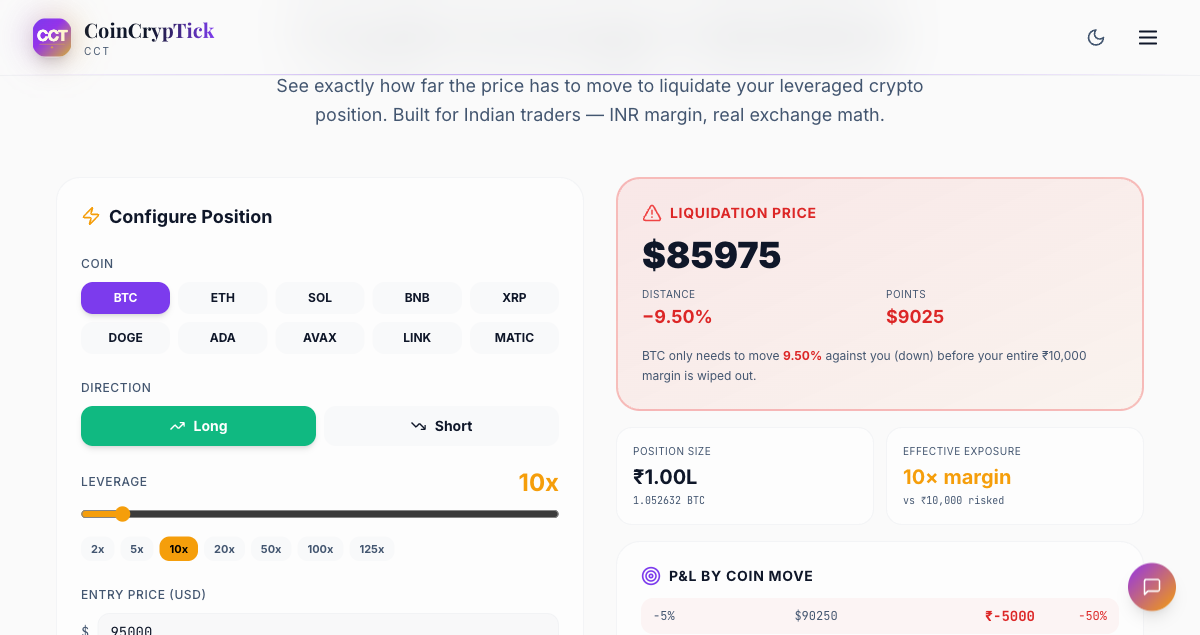
Try it: open our leverage calculator, set your numbers, see what survives.
Rule 2: Never put a stop-loss at a "round" or obvious level
The worst stops:
- $90,000 round
- Below the previous swing low (hit by a wick)
- At the 200-day MA (everyone watches it, market makers wick to it)
Better stops:
- 2-3% below liquidation level (not at it, not at retail S/R)
- 0.3-0.5% beyond the most recent significant wick
- Above visible long-liquidation clusters on the heatmap
If your stop is where 10,000 other retail traders have theirs, expect to be wicked out together.
Rule 3: Position-size by volatility, not by gut feel
Different coins, different volatility. Same leverage = wildly different risk.
Use 14-day ATR (Average True Range) as your position-size sanity check:
| Coin | 14d ATR % | Your "feels right" leverage | Safe leverage | |---|---|---|---| | BTC | 2-3% | 25x | 5-10x | | ETH | 3-4% | 25x | 5-8x | | SOL | 5-7% | 25x | 3-5x | | Mid-cap alt | 8-15% | 25x | 1-3x |
A 25x position on a small-cap with 12% daily ATR is essentially gambling. Same leverage on BTC at 2% ATR is borderline manageable.
You can check live volatility via our volatility lab which shows ATR alongside session-by-session ranges.
Rule 4: Don't hold leveraged positions through funding extremes
When funding rate exceeds ±0.10%/8h, you're paying or receiving 110%+ annualized. Crowding extreme. Cascade likely within 24-72 hours.
Three concrete rules:
- Funding above +0.15%/8h: close longs, even profitable ones. Re-enter after the wick.
- Funding below -0.10%/8h: close shorts, capitulation reversal often near.
- Hold through settlement only when funding is between -0.05% and +0.05%: neutral, no payment penalty.
Watch funding live on our funding rates dashboard.
Rule 5: Reduce leverage in high-volatility regimes
The same 10× position behaves like 30× during volatility spikes. Why? Because:
- Bid-ask spreads widen → exchange uses worse fill price during liquidation
- Mark price diverges from index price → liquidation triggers earlier
- Order books thin out → cascade depth increases
Practical cue: when 1H candles regularly exceed 1.5% in either direction, halve your usual leverage. Wait for volatility to compress (multiple 0.3% candles in a row) before sizing back up.
The non-negotiable habit
Before every single leveraged trade, run this 30-second checklist:
- ✅ Liquidation distance is at least 2x my stop distance
- ✅ Stop is not at a round number or obvious S/R
- ✅ Position size accounts for the coin's actual ATR
- ✅ Funding rate is between -0.05% and +0.05% (or I'm scalping <2 hours)
- ✅ I can name the macro/news event that could blow up this trade
If you skip any one, reduce leverage until the answer is yes.
Quick start
- Open our free leverage calculator
- Plug in your next trade's coin, entry, leverage, and margin
- If liquidation is closer than 2× your planned stop, drop the leverage and recalculate
- Re-run after every changed parameter
The traders who've stopped getting liquidated didn't get smarter or luckier. They just stopped picking leverage based on excitement and started picking it based on math.
Disclaimer: This article is for educational purposes only and does not constitute financial advice.
---