Bitcoin Leverage Trading India: How Much Leverage is Too Much?
Practical breakdown of safe leverage levels for BTC and ETH futures on Indian exchanges. With a free calculator to see your exact liquidation price.
 By Archit Mittal
Most retail crypto traders pick a leverage based on what feels exciting, not what survives. The result: 60-70% of leveraged positions on Indian exchanges get liquidated within 7 days.
This guide gives you the answer in 5 minutes — no theory, just numbers.
The math nobody shows you
A leveraged position liquidates when price moves against you by roughly (100% ÷ leverage) − 0.5% maintenance buffer.
| Leverage | % Move to Liquidation | |---|---| | 2x | 49.5% | | 5x | 19.5% | | 10x | 9.5% | | 25x | 3.5% | | 50x | 1.5% | | 100x | 0.5% | | 125x | 0.3% |
Now compare that to what Bitcoin actually does in normal trading:
- Average 1-hour candle: 0.5-1.5%
- Average 4-hour candle: 1-3%
- Daily wick range: 2-5%
- News-driven minute candle: 0.5-2%
At 100× leverage, the average 1-hour candle can liquidate you. At 50× leverage, a normal 4-hour candle can. Above 25× is statistically a coin flip on any direction trade.
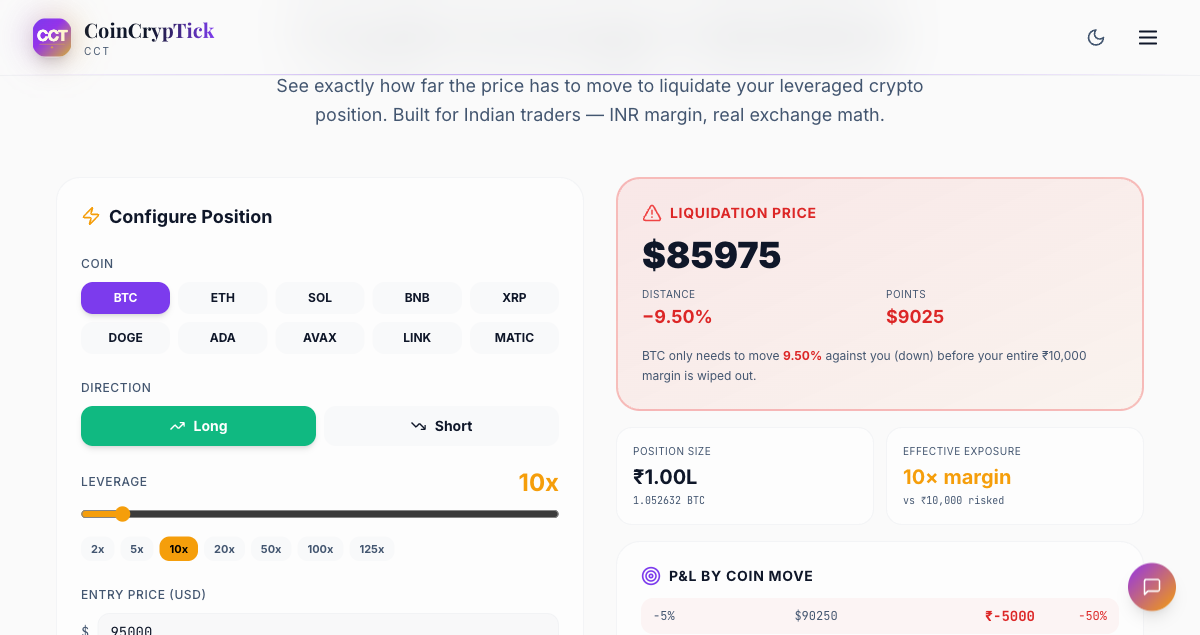
Try it yourself with our free leverage calculator — pick BTC, set 50x, watch how a 1.5% move wipes out your margin.
What pros actually use
After analyzing trades from public Bybit and Binance leaderboards in 2025-26:
- Top 10% of profitable traders: average leverage 3.2x
- Bottom 50%: average leverage 28x
- Worst 10%: average leverage 64x
The pattern is clear. The leverage levels you see promoted on Twitter (50x, 100x) are not what consistently profitable traders use.
Practical leverage rules for Indian traders
- Default to 2-3x for any trade you can't watch every hour. Survives normal volatility, builds account equity steadily.
- Use 5-10x only on confirmed setups with clear stop loss and a target within 24 hours.
- Never go above 20x unless you're scalping with sub-15-minute holds and tight stops at obvious levels.
- Avoid above 50x entirely unless you treat it as gambling money. Position size accordingly.
What changes when you trade on CoinDCX vs Binance
Indian exchanges typically offer 25x max on BTC perps; offshore exchanges go up to 125x. Don't take this as a recommendation to use 125x. The lower max on Indian exchanges is a feature — it pushes you toward survivable leverage.
Cost-wise, leverage trading in India is taxed at 30% flat under Section 115BBH on profits (no LTCG benefit), with 1% TDS on transfers above ₹50,000 per FY.
How to actually pick leverage for a trade
For every trade, work backwards:
- Decide your stop-loss in % terms (where the trade is invalidated).
- Decide max risk in ₹ (recommended: 1-2% of capital).
- Calculate leverage so that stop-loss = max risk.
Example: Account ₹5,00,000, max risk 1% = ₹5,000. Stop-loss is 4% from entry. Required position size = ₹5,000 ÷ 0.04 = ₹1,25,000. Leverage = ₹1,25,000 ÷ ₹50,000 margin (or whatever you commit) = 2.5x.
Most traders pick leverage first and then place stops. That's backwards — leverage should be the output, not the input.
Quick gut check
Before any leveraged trade, run our leverage calculator with your exact entry, leverage, and margin. If the liquidation price is closer than the next obvious support/resistance level, your leverage is too high.
Disclaimer: This article is for educational purposes only and does not constitute financial advice. Leveraged trading carries significant risk including total loss of margin.
---