Crypto Funding Rates Explained: How to Read Them and Trade Crowded Positioning
How perpetual futures funding rates work, what positive vs negative funding tells you about trader positioning, and 4 setups that consistently fade extreme funding.
 By Archit Mittal
Funding rate is the most underused free signal in crypto. Every 8 hours, every perpetual futures market on every major exchange publishes a number that tells you exactly how crowded one side of the trade is. Learn to read it, and you have an edge over 90% of retail traders who ignore it entirely.
This guide explains what funding rates are mechanically, what extreme readings mean for price, and four specific setups professional traders use to fade crowded positioning.
What funding actually is
Bitcoin perpetual futures don't have an expiry date. To keep their price tethered to the underlying spot price, exchanges use a funding rate — a periodic payment between long and short holders.
- When funding is positive: longs pay shorts. The funding rate is, say, +0.05% per 8 hours. If you hold a Rs 1,00,000 long position, every 8 hours you pay Rs 50 to the short side.
- When funding is negative: shorts pay longs. If funding is -0.03%, a Rs 1,00,000 short pays Rs 30 to longs every 8 hours.
The funding rate is not the cost of opening a position — it's a recurring payment that nudges the perp price toward spot. When perp trades above spot (longs are paying premium), funding goes positive to incentivize shorts and disincentivize longs, pulling the price back down.
What different funding levels mean
Funding rates vary by exchange but on Binance, Bybit, and OKX they cluster within tight bands:
- 0% to ±0.01%: Neutral. No meaningful crowding either way.
- ±0.01% to ±0.05%: Mild bias. Normal for trending markets.
- ±0.05% to ±0.10%: Crowded. One side is clearly dominant.
- ±0.10% to ±0.25%: Very crowded. Often precedes a violent unwind in 24-72 hours.
- ±0.25%+: Extreme. Historically followed by 5-15% moves in the opposite direction within a week.
Annualized, +0.10% per 8 hours = ~110% per year of funding cost. Nobody pays that for long.
Why funding signals reversals
The mechanism is purely behavioural: when too many traders bet one direction, they bid the perp away from spot. The funding rate makes their position expensive. Eventually, weak hands stop paying funding and close — which on the long side means selling perps, dragging price down. The unwind cascades through stop losses.
This is why extreme positive funding precedes corrections even when spot looks healthy: traders are leveraged long, paying up daily, and one bearish catalyst — or just exhaustion — flips the cascade.
The same applies in reverse: extreme negative funding (heavy shorts) often precedes sharp upmoves as shorts cover.
The 4 setups that work
Setup 1: Mean-reversion at funding extremes
Trigger: BTC perp funding crosses ±0.15% per 8 hours on Binance for two consecutive periods.
Action: Take a counter-position with strict size:
- Funding +0.15% or higher → short BTC perp, max 1% of capital, target -3% to -5%, stop +2%
- Funding -0.15% or lower → long BTC perp, same parameters
Why this works: This is the "pay attention" zone where weak hands start capitulating. Historical hit rate over 2022-2026 on BTC: ~65% win rate at 1.5R average.
You can monitor funding extremes live via our funding rates tool which colour-codes pairs in the danger zone.
Setup 2: Funding rate divergence
Trigger: BTC price makes a new local high but funding rate is lower than at the previous high.
Interpretation: Less aggressive long-side leverage. Either the rally is more spot-driven (healthier) or longs are tired. Either way, the divergence often precedes either a clean continuation (spot-driven) or a fakeout fade.
Action: Don't trade the divergence directly — use it as a filter. If funding diverges down on a new high, your long bias should reduce. If it diverges up on a new high, you have crowd confirmation, but also crowding risk.
Setup 3: Funding flip after capitulation
Trigger: BTC dumped 8-15% in 24-48 hours. Funding goes negative for three consecutive periods. Open Interest falls 15%+ from local high.
Interpretation: Forced unwinds done, shorts entering, panic over.
Action: Long perp on the third negative funding read, target a 50% retrace of the dump, stop below the recent low.
This setup is rare (3-5 times per year) but produces the highest reward-to-risk because you're entering after capitulation.
Setup 4: Cross-coin funding spread
Trigger: BTC funding is at -0.05% while ETH funding is at +0.15%. Or vice-versa.
Interpretation: Crowd is rotating capital. They're piling into one and exiting the other.
Action: Long the unloved (negative funding), short the loved (positive funding) as a pair trade. Equal notional both sides. Profit comes from convergence, not market direction.
Reading the funding rate alongside Open Interest
Funding alone is half the picture. Combining with Open Interest (OI — total notional outstanding) tells the full story:
| Funding | OI Change | Interpretation | |---|---|---| | Positive | Rising | Aggressive long building. Crowded. Watch for blow-off. | | Positive | Falling | Longs covering. Underlying strength. Bullish. | | Negative | Rising | Aggressive short building. Watch for short squeeze. | | Negative | Falling | Shorts covering. Underlying weakness. Bearish. |
Most amateur traders look at price + RSI. Adding funding + OI to your daily review changes how you read crowding entirely.
Common funding rate mistakes
Mistake 1: Trading funding signals on shitcoins. Funding extremes on small-cap perps can stay extreme for weeks because liquidity is too thin to enforce convergence. The setups above only work reliably on BTC, ETH, and the top 5-10 alt perps.
Mistake 2: Ignoring funding when entering longer-term positions. A multi-week swing long entered when funding is at +0.20% loses 1-2% per week to funding payments before any price move. Wait for funding to normalize before sizing in.
Mistake 3: Using one exchange's funding only. BTC funding can be +0.10% on Bybit and -0.02% on OKX simultaneously due to different premium rules. Aggregate or use a tool that shows multi-exchange averages.
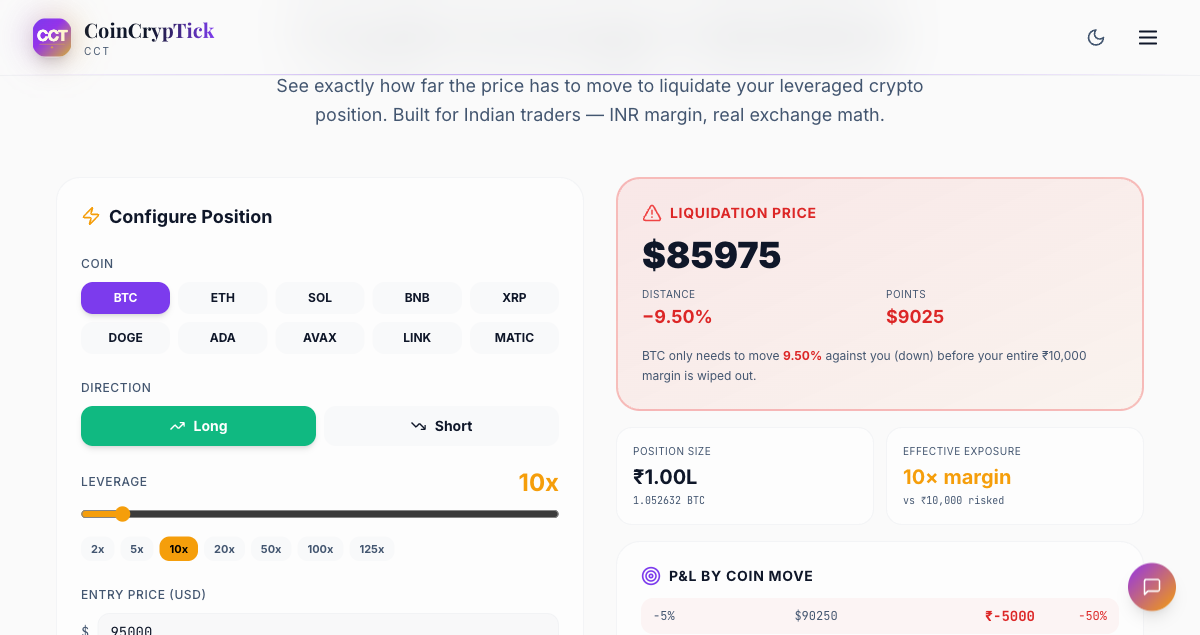
Mistake 4: Confusing funding with leverage cost. Funding is paid on the notional of your position, not your margin. A 10x leveraged long with Rs 10,000 margin has Rs 1,00,000 notional — funding is calculated on the Rs 1,00,000.
How to measure funding cost on a trade
Before entering any leveraged position, run this calc:
- Days you expect to hold: X
- Funding rate per 8 hours: F (in %)
- Total funding cost as % of position: X × 3 × F (since 8 hours × 3 = 24 hours)
Example: holding a long for 5 days when funding is at +0.05%:
- Total funding paid = 5 × 3 × 0.05% = 0.75% of notional
If your target is +3%, funding eats 25% of the move. If your target is +1%, funding eats 75%. This calculation alone makes you a more selective trader.
Tools and data sources
- Coinglass.com — best free aggregator, shows funding by coin and exchange
- Velo.xyz — institutional-grade, paid, but worth it for active traders
- CoinCrypTick funding tool — funding rates with built-in alert logic when extremes hit
- Direct exchange APIs — Binance and Bybit publish funding rates with full historical data (free)
For Indian traders specifically: most Indian exchanges (CoinDCX, Bitbns) compute their own funding rates that are usually correlated to Binance/Bybit but can differ by 0.02-0.05%. If you're trading on an Indian perp, check the local rate, not the offshore one.
A note on derivatives and Indian regulation
Trading crypto perpetual futures on Indian exchanges is allowed and TDS-compliant. Trading on offshore exchanges (Binance, Bybit) is technically allowed but TDS responsibility shifts to you, and FIU-IND compliance gets harder. For Indian traders, CoinDCX perps cover BTC, ETH, and most top-50 coins.
Summary
Funding rates are one of three or four free signals in crypto that genuinely move alpha. They show you what the crowd is doing in real-time and where the pain threshold lies. Add a daily check of funding extremes to your trading routine. The setups above are the ones that have worked on BTC and ETH from 2020 through 2026 — the underlying behavioural mechanism (forced unwinds at extreme funding) is unlikely to change as long as perps exist.
Disclaimer: This article is for educational purposes only and does not constitute financial advice. Leveraged trading carries significant risk of loss.
---